Tuesday, September 3, 2024

Notes: Oracle Key Vault 21.9 concepts


OKV 21.9 Concept notes:


url: https://docs.oracle.com/en/database/oracle/key-vault/21.9/okvag/okv_concepts.html#GUID-9A18985D-B7B7-499A-8920-1E00CDB52A50


Endpoints: computer systems where security objects are needed to access the data. The security objects must be efficently managed

Endpoints needs to be enrolled to communicate with OKV

Related security objects can be added to a virtual wallet for ease of wallet management.

Endpoints always have a default wallet, so they become the default virtual wallet if no explicit wallet creation is done.


Deployment architecture:

1. Appliance (OKV<RDBMS & GG<Oracle Linux)

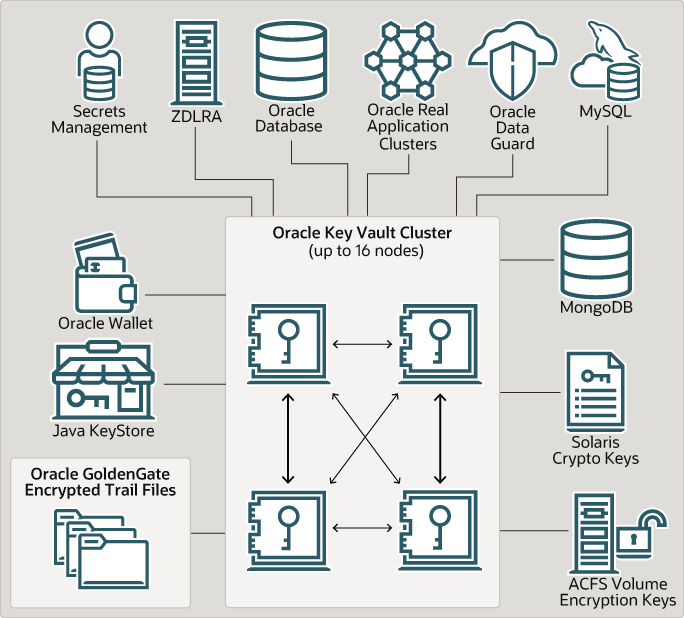
2. Standlone or multimaster with upto 16 nodes (2 of which needs to be RW pair)

3. Large enterprise  : Multimaster with multiple nodes needs to be considered.

4. For small single DC (data doesnt leave the DC): single read-write pair (2x OKV) needs to be considered

5. Standalone deployments can be used for testing and development purposes
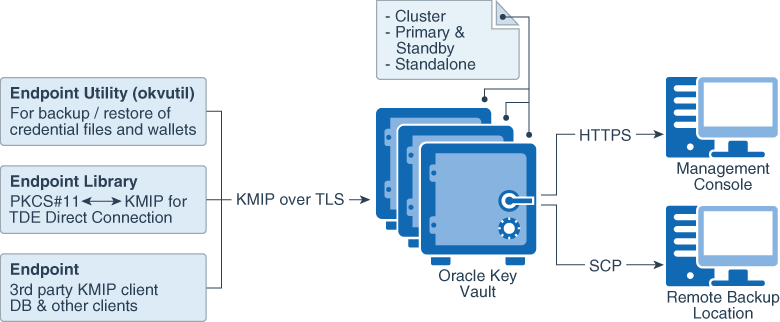

Description of Figure 2-1 follows


Access control & grants:

Users < access at security object leve or virtual wallet level

grouping of users and endpoint is also possible - this way user group and end point groups get access.


access controls: read, write, delete


# 3 categories of access controls:

1. Read only

2. Read & Modify - grants read and modify access to the security object

3. Manage Wallet - user should already have read and modify permission + with this role, user grant the permission to other users/endpoint (groups) and also delete the security object/wallet or change its description


Seperation of duties:

Key vault admin: manage security objects and maintain the lifecycle of the security object

System admin : OKV backup/recovery/enroll endpoint/create users and groups, stop/start keyvault,setting up and managing a cluster

audit admin: audit related tasks, has read access on all security objects, manage audit settings

endpoint administration roles: create, manage endpoint (groups) -- these are non administrative roles.


Less privileged endpoint permissions:

endpoint specific : create/manage - system admin owned

endpoint group specific: create/manage - key vault admin owned

These less privileged can be granted to users who didnt create the security object as well.

Admin Roles

super privileged roles

System Admin

OKV stop/start, OKV backup/restore, Create/Manage endpoint/user, Setup/Manage Cluster

Key vault admin

Create/Manage endpoint groups, Maintain security objects lifecycle

Audit admin

audit related tasks, has read access on all security objects, manage audit settings


Non Admin role privileges


Privilege or role

type?

Who owns this role?

Description

Create endpoint

system

owned by system admin role

create & manage endpoint (auto granted, can be revoked)
system admin role, even if revoked from a user, they can still
manage the endpoints they created. Just that they cant create new endpoints.
System admins only can revoke create endpoint permission from others.
user with create endpoint permission on deletion has no impact on the endpoints they created. The management responsibility of the endpoint goes to system admin role if no one else with manage that endpoint exist in the system

Manage endpoint

object

owned by system admin role

Allows users to reenroll, suspend, delete, resume endpoints
System admin only grant/revoke this role. If system admin role is revoked from a user, the manage end point permission goes away, unless create endpoint granted at that time of the endpoint creation from the admin; default wallet can be set by the user. Deletion of the user with manage end point; will lead to either system admin or other user with same manage endpoint to manage the endpoint.

Create endpoint group

system

owned by keyvault admin

user with create endpoint group auto gains manage end point group as well as soon admin creates a endpoint group; but that can be disabled seperately. As like endpoint create system permission, the system admin role revokation wont remove manage endpoint group permission for those end point groups created by them; grant/revoke only OKV admin can do this; deletion of user will lead to other end point managers to manage the group or okv admin manages the request.

Manage endpoint group

object

owned by keyvault admin

manage all the endpoint group operations, adding the endpoint group from/to other groups; delete endpoint group. The endpoint group inherits permission as users from wallet. Only OKV admin can grant/revoke the permission; inheritance flows from user group to user or endpoint group to the group/user'. deletion of endpoint group will lead to other end point managers to manage the group or okv admin manages the request.


Object naming convention:

users - [a-z,A-Z],[0-9],[_]

groups, user groups, wallets, endpoint - [a-z,A-Z],[0-9],[_][.][-]

users, usergroups, endpoint, endpoint group - case insenstive

Virtual wallet is case sensitive


Recover passphrase: setup during install, it is needed during mutlimaster node addition , when all admin users not available, backup/restore; only way to recover this credential is to reinstall OKV.

recovery passphrase

Once lost, the OKV needs to be reinstalled. This passphrase supports
1. new node addition
2. backup/restore

root user

ssh disabled, also only needed during patching & maintenance only

support user

ssh is enabled, it is the common tty linux terminal user

End point managers

permission to provision end point

End point admin

It by default has create & manage endpoint. In case needed we can regrant the *group permision as well. So this user becomes single user to manage all endpoint related operations


Sunday, September 1, 2024

Notes: Introduction to OKV 21.9

 Intro to OKV: https://docs.oracle.com/en/database/oracle/key-vault/21.9/okvag/okv_concepts.html#GUID-36CEA9A9-33C0-495A-B224-9259B08DA072


full stack : security hardended software built to centralize the management of keys and security objects within enterprises


okv - Secretes management appliance which is fault tolerent, ha,scalable, secure, standards compliant


okv - centralizes the key store/retrival/lifecycle


Security Objects the OKV can manage are:

1. Encryption keys

2. Oracle wallets

3. Java Keystores

4. Java Cryptography extension key stores

5. Credential files (ssh keys, db account passwords)


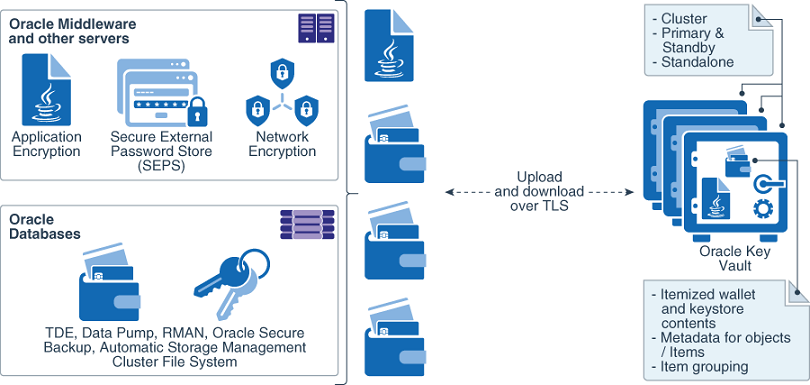
OKV build on - refer to picture (01sep2024 - picture 1)


OKV application


DB


Vault


OBJ - VPD


TBS  - TDE


Golden Gate


Oracle Linux


oracle linux, oracle db (vault, vpd, tde), golden gate


optimized for TDE, KMIP compatible clients


standards it is aligned: OASIS KMIP


End point: Computer systems - db server, app server


(01sep2024 - picture 2)


DB


OKV


APP


secuity objects


benefits:

1. create, rotate, delete security objects (ex.: keys)

2. prevent loss of keys and wallets due to accidental deletion of passwords or forgotten passwords

3. share among authorized end points (rac cluster)

4. full stack includes all needed binary (including clients)

5. works with other products - tde, rac, dataguard, pdb


>okv use cases:


Online master encryption is used to centralize the TDE management over direct network.

2 types of scenarios:

 a. db already encrypted

 b. db yet to be encrypted


In either case, storing the tde key on the local wallet means, we need to copy/remove the wallet files manually across dependent systems; vs the OKV the key gets shared automatically based on endpoint permissions. Changes are immediately reflected.


online master encryption is supported from 12.1.0.2 to 23ai


Description of Figure 1-1 follows


The following systems benefit from the centralized key management:

1. Oracle RAC

2. Dataguard

3. Shards

4. expdp/impdp operations


Centralized management of security objects might result in storing/retrival/backup/recovery/retaining/tracking for longer time seemless. If not we will need manual tracking of trail of file copy and manament of the same is needed.


OKV can manage the security objects contained within wallets (encryption key, passwords, X.509 certificates)

Refer to picture 4 for more details.


Description of Figure 1-3 follows


Credential files like:  keys, ssh keys, passwords are treated as opaque files and are stored/retrived as it is.


Methods to access the security objects: RESTful API and okvutil


Target audience: dba or security administrator or other information security personal


major features:

Centralized management of keys and secrets (creation, distribution and deletion)

Audit trail for external auditors

MySQL encryption keys are supported

ACFS encryption

OKV can use RoT

Fault tolerent, secured, high available, scalable


Centralized management of security objects:


Online master encryption key (creation and migration of encryption key to OKV)

wallets - the wallet file once archived oin key store can be retrieved in case of the accidental deletion in the source

crdential files - ssh keys and kerberos keytabs are stored/retrived as needed across endpoints trusted

certificate files - .cer, .crt, .der, .p12, .pem etc.. stored/retrieved


SSH key (credential management): admins' public key is added to OKV and distributed as per access requirement. ssh keys can be rotated as needed, key length and usage requirements.


Reports and alerts:

OKV audits usage of all the security objects

Alerts to be sent for expiration, usage, limits; the alerts can be sent to external systems as well


3 users in OKV: key vault admin, audit admin, system admin

4th user : endpoint admin is specific to the end point


Persistent Master Encryption cache: is targetted mainly at standalone or primary-sby architecture, where the single master isnt available. In multimaster deployment it is never a concern.


OKV performs backups to local as well remote systems. OKV performs hot backup so non disruptive. OKV performs incremental backups as well.


OKV uses restful services to deploy/manage/configuration/administration of endpoints,wallets,access controls, backup operations at scale. Restful services can also be used to automate the OKV tasks in endpoints.


OKV supports 12.1.0.2 to 23ai

Mysql windows platform isnt supported

OKV can use a RoT (Root Of Trust) to protect encryption keys

HSM are build with tamper resistant hardware


Central OKV management

OKV GUI


Endpoint management

okvutil

restful services

OKV SDK